The Psychology of the Near-Miss in Hyper-Casual Design
By Plarmes
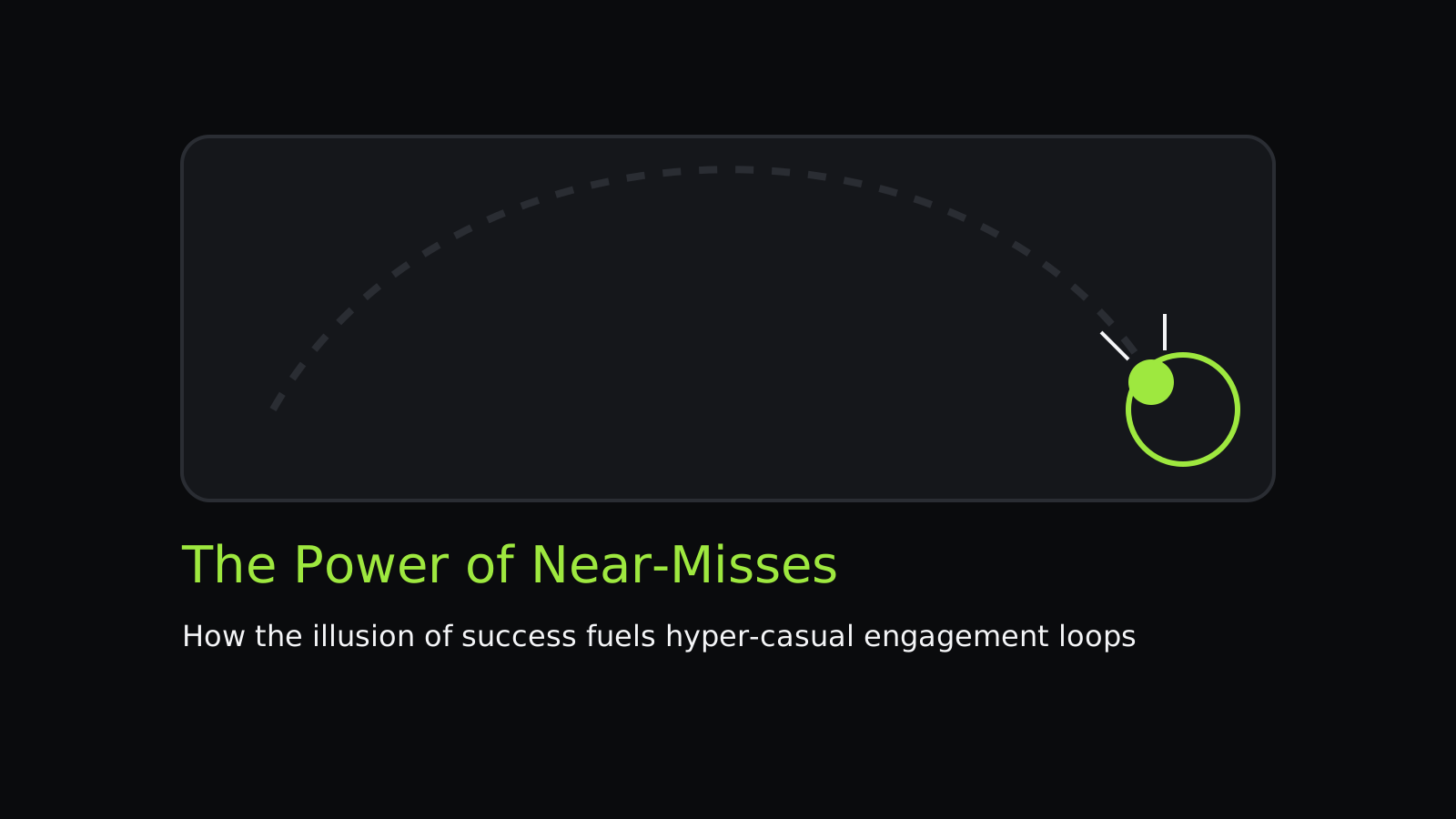
In the world of hyper-casual gaming, where sessions are measured in minutes and the barrier to exit is a single swipe away, developers must master the art of the 'one more try.' While high-quality art and satisfying feedback loops are essential, one of the most powerful psychological tools in a designer's arsenal is the near-miss. A near-miss occurs when a player fails to achieve a goal but comes tantalizingly close to success. This specific type of failure does not discourage the player; instead, it provides a unique cognitive stimulus that often proves more addictive than success itself. Understanding how to engineer these moments can be the difference between a game that is played once and a game that stays on a user's phone for months.
The Mechanics of 'Almost There'
The near-miss effect is a well-documented phenomenon in behavioral psychology, most famously observed in the gambling industry. When a slot machine displays two matching symbols and the third symbol lands just one position away from a jackpot, the player's brain processes the event not as a loss, but as a 'near-win.' In hyper-casual games, this translates to the ball hitting the rim of the hoop and bouncing out, or a runner missing the finish line by a fraction of a second. From a neurological perspective, a near-miss triggers a significant release of dopamine. The brain interprets the closeness of the result as a signal that the current strategy is almost correct, prompting the individual to repeat the behavior to achieve the desired outcome.
For game designers, this means that the 'fail state' should never feel like a total collapse of the player's agency. If a player misses a platform by a wide margin, they often attribute the failure to a lack of interest or an unfair difficulty spike. However, if they graze the edge of the platform and fall, they attribute the failure to a minor personal error. This internal attribution is crucial. It convinces the player that success is within their reach, provided they give it one more attempt. This is the heart of the hyper-casual loop: reducing the perceived distance between failure and success.
Why the Brain Craves the Near-Miss
The reason the near-miss is so effective is rooted in the concept of 'variable ratio reinforcement.' This is a schedule of reinforcement where a response is reinforced after an unpredictable number of responses. When a player almost wins, the brain enters a state of high arousal. Research suggests that the physiological response to a near-miss—such as increased heart rate and skin conductance—is remarkably similar to the response triggered by an actual win. In some cases, the frustration of the near-miss actually intensifies the desire to play, as the player seeks to resolve the cognitive dissonance created by 'almost' winning.
In hyper-casual design, we can leverage this by creating 'zones of proximity.' These are areas around a target or a success condition where a failure is visually and mechanically framed as a narrow escape or a close call. If the player is playing a knife-throwing game, having the knife vibrate against the wood right next to the target is more engaging than having it fall completely off the screen. The closer the fail is to the win, the higher the player's motivation to restart immediately.
Implementing Near-Misses in Hyper-Casual Physics
Implementation of near-misses requires a delicate balance between honest physics and 'curated' outcomes. While players value a sense of fairness, many successful hyper-casual titles subtly nudge the physics to favor near-miss situations. For example, a game might use an 'invisible magnet' effect that slightly pulls an object toward a goal but lets it fail at the last millisecond if the player's input wasn't perfect. This creates a more dramatic visual than a standard linear trajectory.
Visual feedback is paramount here. The animation of the failure must emphasize the proximity. Use 'slow-motion' triggers when a player is within a certain distance of a lethal obstacle or a high-value goal. This expands time for the player, making the 'near-miss' feel even more visceral. If a character is jumping over a rotating saw blade, a near-miss should ideally result in a 'close shave' animation rather than an instant, static game-over screen. By emphasizing how close the player came to surviving, you amplify the emotional stakes of the next run.
The Connection to Ad Monetization
Beyond retention, the near-miss is a primary driver for 'Rewarded Video' ad placements. The 'Continue' button is the most effective monetization tool in the hyper-casual genre, but it only works if the player feels that the current run is worth saving. A player is exponentially more likely to watch a 30-second advertisement to continue their progress if they died right before a milestone or the level exit.
By designing levels that naturally bottleneck or increase in complexity right before a reward or a finish line, designers create more opportunities for near-misses. When a player fails at 95% completion, the 'sunk cost fallacy' kicks in. They have already invested time and effort into the level, and the near-miss provides the emotional 'spark' needed to justify watching an ad to bridge the small gap remaining. It turns the advertisement from an interruption into a valuable utility that helps the player overcome a minor setback.
Avoiding the Frustration Trap
While near-misses are powerful, they must be used ethically and strategically. If every single death is a near-miss, the player will eventually realize the game is manipulating them. This leads to a loss of trust and a feeling that the game is 'rigged.' To maintain the efficacy of this mechanic, you must mix near-misses with 'clear misses.' Clear misses provide a baseline for the player's skill level, making the near-misses feel more authentic when they do occur.
Furthermore, the game must remain responsive. A near-miss should never feel like it was caused by 'lag' or poor hit-detection. If a player feels they were robbed by the game's code rather than their own thumb, the dopamine rush is replaced by genuine anger. High-quality haptic feedback and crisp sound design can help 'sell' the near-miss as a physical event in the game world, rather than a mathematical calculation.
Calibrating Your Game for Long-Term Retention
To properly calibrate near-misses, developers should look at their 'death heatmaps' and completion rates. If players are consistently failing at the same spot with a wide margin, the level is too hard. If they are failing with narrow margins but not hitting the 'restart' button, the fail state might not be 'juicy' enough. The goal is to reach a state where the 'distance to goal' at the moment of death is frequently small enough to trigger that 'I almost had it!' reaction.
In conclusion, the near-miss is not just a coincidence of physics; it is a deliberate design choice that speaks to the way our brains process reward and failure. By framing loss as a stepping stone to success, hyper-casual games can transform a potentially negative experience into a compelling reason to stay engaged. Master the near-miss, and you master the player's attention.
Further reading: The Psychology of Satisfying Game Juice and Art of the Fail State in Hyper-Casual.